
Back in 2021, I stumbled across a statistic that hit me harder than a hardcore raid boss: the percentage of women graduating with Computer Science degrees was projected to drop to just 22% by 2022. As someone who grew up gaming and dreaming of a career in tech, that number felt like a gut punch. Since then, I’ve kept a close eye on programs that try to shake up that trajectory. One that stays with me is Blizzard Entertainment’s \u201cGirls Who Code\u201d summer camp. Even five years later, its ripple effects are worth talking about\u2014because honestly, the fight for a diverse STEM pipeline never really ends.
The program itself was designed for a very specific audience: girls (both cis and trans) in 10th through 12th grade. No prior coding experience was needed. Over the summer, they learned directly from actual Blizzard developers\u2014engineers, designers, cinematic artists\u2014who volunteered their time to teach basic computer science concepts, build confidence, and show them what\u2019s possible in tech. I remember thinking how rare that kind of access felt. Most of us figure out what a game developer does only after years of reading forums or watching YouTube deep dives. These teenagers were getting that exposure at an age when it could still shape their entire path.
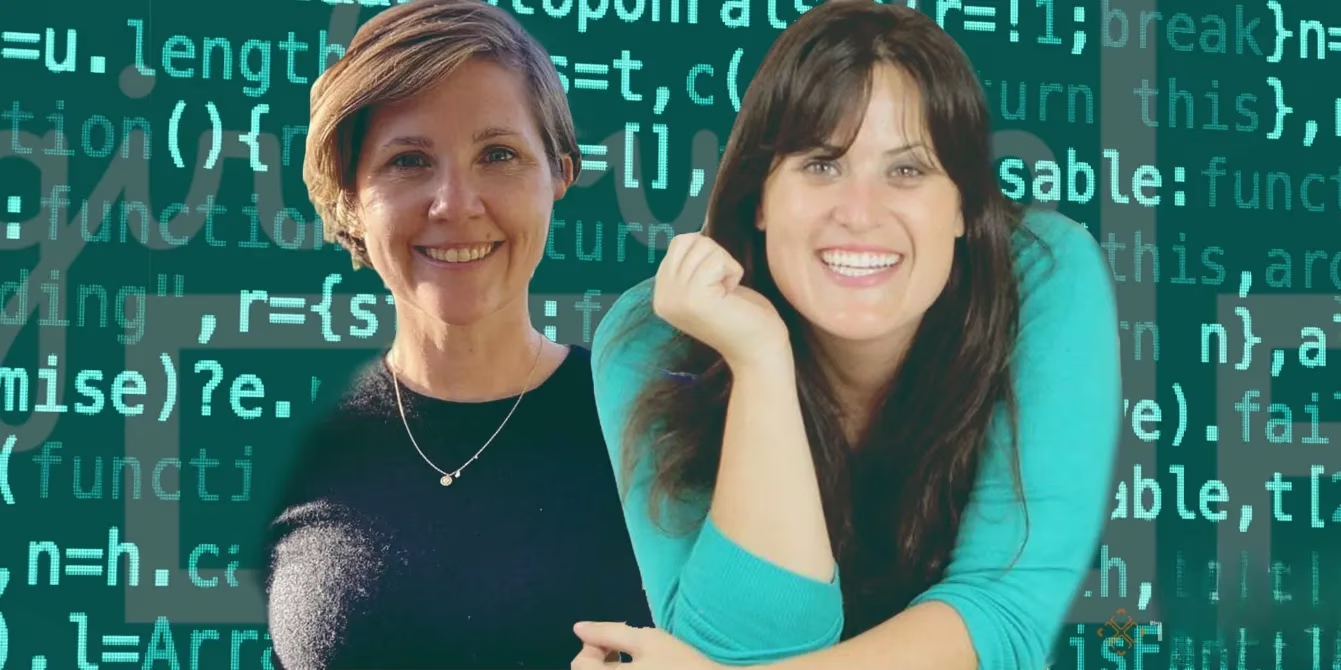
I had the chance to chat with two of the mentors back then, and their words still resonate. Overwatch senior software engineer Julie Anne Brame described an all-too-familiar feeling: walking into a classroom and being the only person who looks like you. \u201cIt does take an element of bravery,\u201d she said. She talked about well-meaning classmates who\u2019d ask if she was lost. \u201cI appreciate you\u2019re trying to be nice, but no, I belong here.\u201d That mix of grit and grace is something every woman in tech understands on a bone-deep level. It\u2019s not just about being present; it\u2019s about \u201cI\u2019m not only going to arrive here, I\u2019m going to succeed here too.\u201d Even now, those words echo in my mind whenever I walk into a game dev meetup and catch a few sideways glances.
Anna Morgan, a cinematic director on Blizzard\u2019s creative development team, added another layer. She reframed failure the way a good game designer would\u2014as a variable you successfully removed. \u201cThere\u2019s no failure, there\u2019s just finding it,\u201d she said. That philosophy has stuck with me like a loading screen tip that actually changes how you play. In tech, every bug you squash, every misstep you troubleshoot, is just one fewer thing blocking your way. For teenagers especially, learning to see failure as data rather than defeat is a superpower.
A huge reason girls don\u2019t rush into STEM is that they genuinely don\u2019t know what\u2019s out there. Morgan put it bluntly: as a kid, she knew she could be a teacher or an actor or an auto parts seller like her dad\u2014but nobody told her computer science was an option. \u201cI didn\u2019t know it existed,\u201d she said. That\u2019s the crux of the problem, isn\u2019t it? You can\u2019t aspire to a role you never see. Blizzard\u2019s program wasn\u2019t about grooming future senior software engineers for the company. It was about exposure. Brame remembered her own high school STEM camp where she launched rockets\u2014fun, but not her final career. Still, it opened her eyes to opportunities that weren\u2019t obvious from the outside. That\u2019s the gift of programs like these: they let you try on different futures before committing.
Of course, we can\u2019t ignore the elephant in the server room: gaming culture itself hasn\u2019t always been welcoming. As the industry has grown, the toxicity in online spaces remains a deterrent for many women. Morgan acknowledged this as a lifelong gamer who raids in World of Warcraft every night. Her advice? Find your people. \u201cThe anonymity of the internet is amazing, [but] it can be awful.\u201d Instead of letting the toxicity in, she focuses on the skills games build\u2014communication, coordination, understanding complex systems. She also pointed out how gaming has bled into everything. \u201cAll of us are playing games now on our phones,\u201d she said. \u201cEven those little workout apps have games.\u201d That normalisation matters. A teenager who plays Candy Crush today might be tinkering in a game engine tomorrow, no longer feeling like an outsider because she \u201cisn\u2019t a gamer.\u201d
Fast forward to 2026, and the impact of that Blizzard summer camp has rippled outward. I\u2019ve seen former participants start coding clubs at their schools, land internships at indie studios, and even speak at conferences about mental health-themed game mechanics\u2014a cause many of them chose to highlight in their camp projects. Morgan told me her heart \u201calmost exploded\u201d watching the end-of-year showcase. The girls built websites that tackled climate change, social justice, sex education, and mental health. Then many of them turned those digital projects into real-world activism. \u201cWe all worry about the world and the younger generations,\u201d she said. \u201cAnd it\u2019s like, no, these girls got this.\u201d
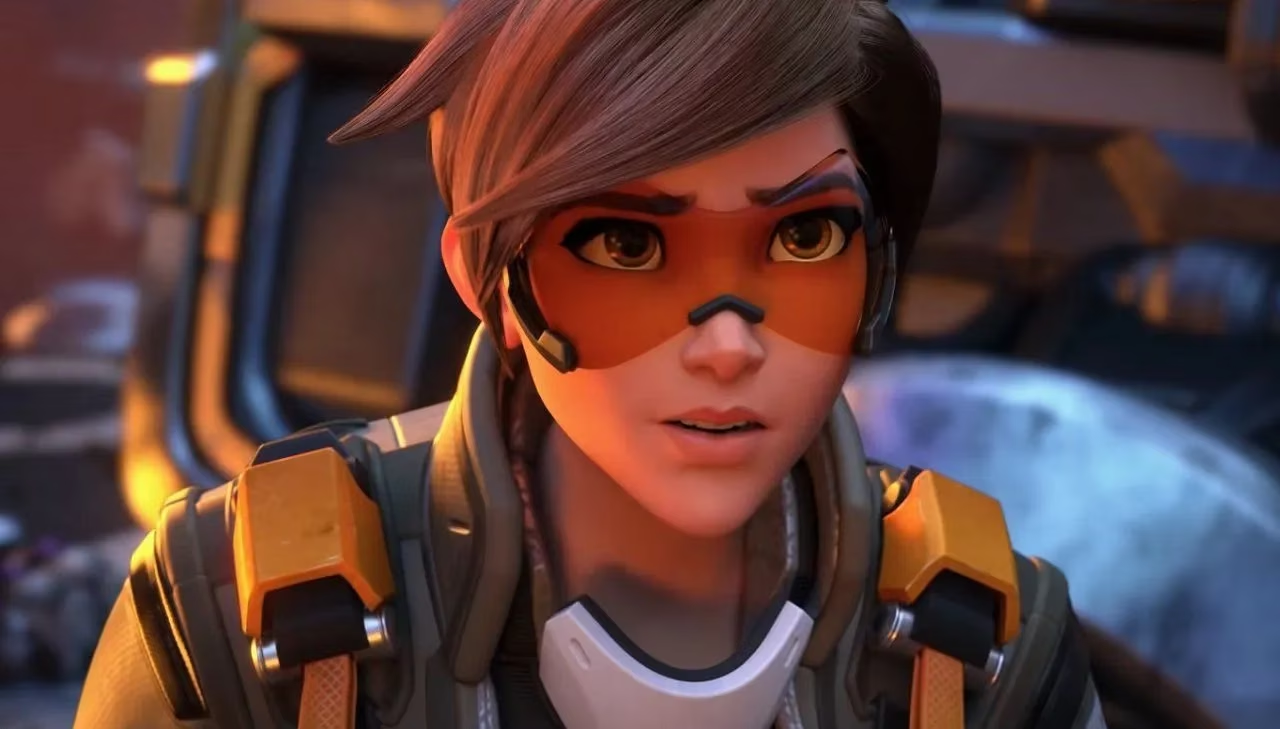
That sentiment is still true. The percentage of women in CS degrees may have nudged up slightly since 2022, but we\u2019re not out of the woods. Programs like Girls Who Code, when backed by companies that actually build the tools and worlds we love, do more than teach Java or Python. They hand over a permission slip to belong. They whisper, \u201cYou\u2019re not lost. You\u2019re exactly where you\u2019re supposed to be.\u201d As a player and a tech enthusiast, that\u2019s the kind of culture I want to see more of\u2014one where the next Tracer isn\u2019t just a hero on screen, but the person coding her next ability behind it.