
I still remember the strange quiet around Blizzard in early 2021. The company had made noise with cinematic reveals and big promises, yet the calendar kept refusing to cooperate. Overwatch 2 and Diablo IV were not coming that year—that was the message, delivered in an earnings call about Q4 2020, and I felt the same mix of disappointment and relief I always feel when a developer finally admits the obvious.
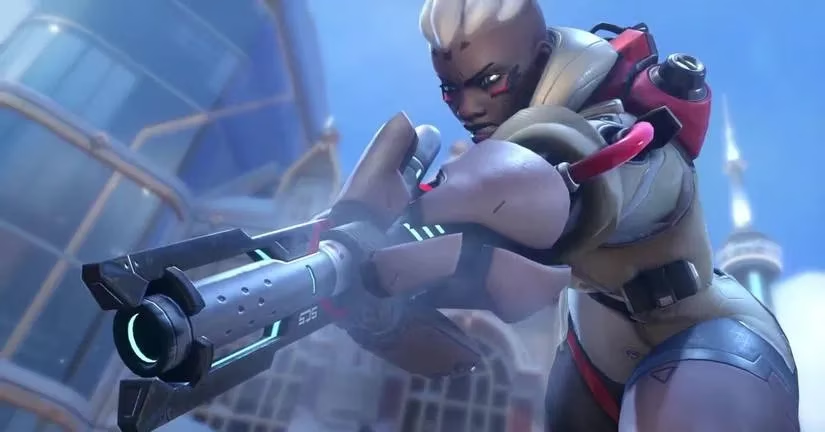
For me, that earnings call was less about dates and more about posture. Blizzard had been fairly tight-lipped for months. The initial announcements had generated plenty of buzz, but by early 2021 the silence had become its own statement. I remember reading that Overwatch 2 had crossed a major internal milestone in December 2020. The president of Blizzard Entertainment at the time said the team was about to accomplish critical testing of some of the game's main features. That sounded encouraging. It also sounded like a project still deep in the workshop, not one about to be placed under my Christmas tree.
Diablo IV was in a similar holding pattern. Blizzard was hoping to lean on the franchise's mobile offerings for that year, with Diablo Immortal and other mobile titles carrying a lot of the public attention. The problem was the kind of attention it attracted. The loudest voices kept saying that nobody wanted a mobile Diablo, and the buzz around Immortal had become a case study in how not to read a room. I understood the frustration. I also understood the business logic. Mobile was where the audience and the money were, whether the hardcore forum crowd liked it or not.
What stayed with me most was the timing of the reveals. Many players, myself included, suspected that the initial announcements were more damage control than anything else. Both titles had been pushed heavily around the time of the Hong Kong controversy, and it was hard not to notice how conveniently those reveals arrived. Maybe that is unfair. Maybe the teams had been working on those games for years and simply chose that moment to speak. But perception matters, and Blizzard's public image was already fraying.
Looking back from 2026, I can see the whole episode as a lesson in the trap of announcing a game too soon. It is nothing new in this industry. Studios tease logos, cinematic trailers, and vague release windows long before the systems are locked, the content is tested, and the teams know what the game actually is. Sometimes the hype helps. Often it becomes a debt that has to be repaid with delays, silence, and awkward earnings calls.
Here is how the story looks to me now:
| Title | What we heard in 2021 | Where it stands in 2026 |
|---|---|---|
| Overwatch 2 | Internal milestone in December 2020; no 2021 launch; expected in 2022 | It launched in October 2022 and became the live, free-to-play face of the franchise, with seasonal updates and a very different content model from the original game |
| Diablo IV | No 2021 launch; expected in 2022 | It arrived in June 2023, with seasonal support and a darker, more grounded direction than Immortal |
| Diablo Immortal | Mobile focus for 2021; mixed buzz | It launched in 2022 on mobile and PC, found an audience, and kept the monetization debate alive |
That table is a reminder that the wait felt endless at the time and almost inevitable in hindsight. In 2021, Overwatch was still a major force in competitive gaming. The original had launched in 2015, and the Overwatch League was still a big seasonal anchor, with the new season set to begin in April. The game's popularity was high enough that Blizzard could afford to take its time. I did not love that answer, but I understood it.
The mobile push was harder to swallow. Diablo Immortal generated buzz for all the wrong reasons before it even launched, and the phrase nobody wants a mobile Diablo became a shorthand for the disconnect between Blizzard and part of its audience. Yet the game did ship. It did find players. And it did prove that the mobile market was not a side quest for the company.
If I could send one note back to my 2021 self, it would be this: the delay was real, but it was not the whole story. The bigger story was how Blizzard had trained its audience to expect announcements before games were ready. That habit created a cycle of hype, impatience, and disappointment that no release date could fix.
So when I look at Overwatch 2 and Diablo IV in 2026, I do not see two abandoned promises. I see two games that eventually arrived after a long, messy, very public gestation. I also see a lesson that the industry keeps relearning: a logo is not a game, a cinematic is not a schedule, and an earnings call is not a release date. 😅
The wait is over now. The debate is not. And I still flinch a little whenever a publisher says the words 'major internal milestone.'