
In the sweltering July of 2021, a fragment of Blizzard’s Overwatch briefly escaped into the wild—an unreleased Deathmatch map dubbed Malevento. A since-removed Dexerto article painted its picture before corporate silence descended like a drawn curtain across a stage. Five years on, that Italian hillside arena endures as a favorite among a diminished but devout player base, its sun-scorched lanes still echoing with the clatter of pulse rifles and the hum of gravitic flux.
Perched on a fictional Tyrrhenian slope where cypress shadows stripe terracotta rooftops, Malevento arrived as a curated puzzle box for solo combat. The layout married narrow, cobblestone veins to broad piazzas, each vista carefully dressed with vehicles that seemed plucked from a 1960s concours meet yet refitted with holographic dashboards. At the very center, a Talon headquarters squatted like a metallic tumor inside the old stone belly of the village—armored doors, angular black facades, and crimson banners declaring dominion over the quaint surroundings.
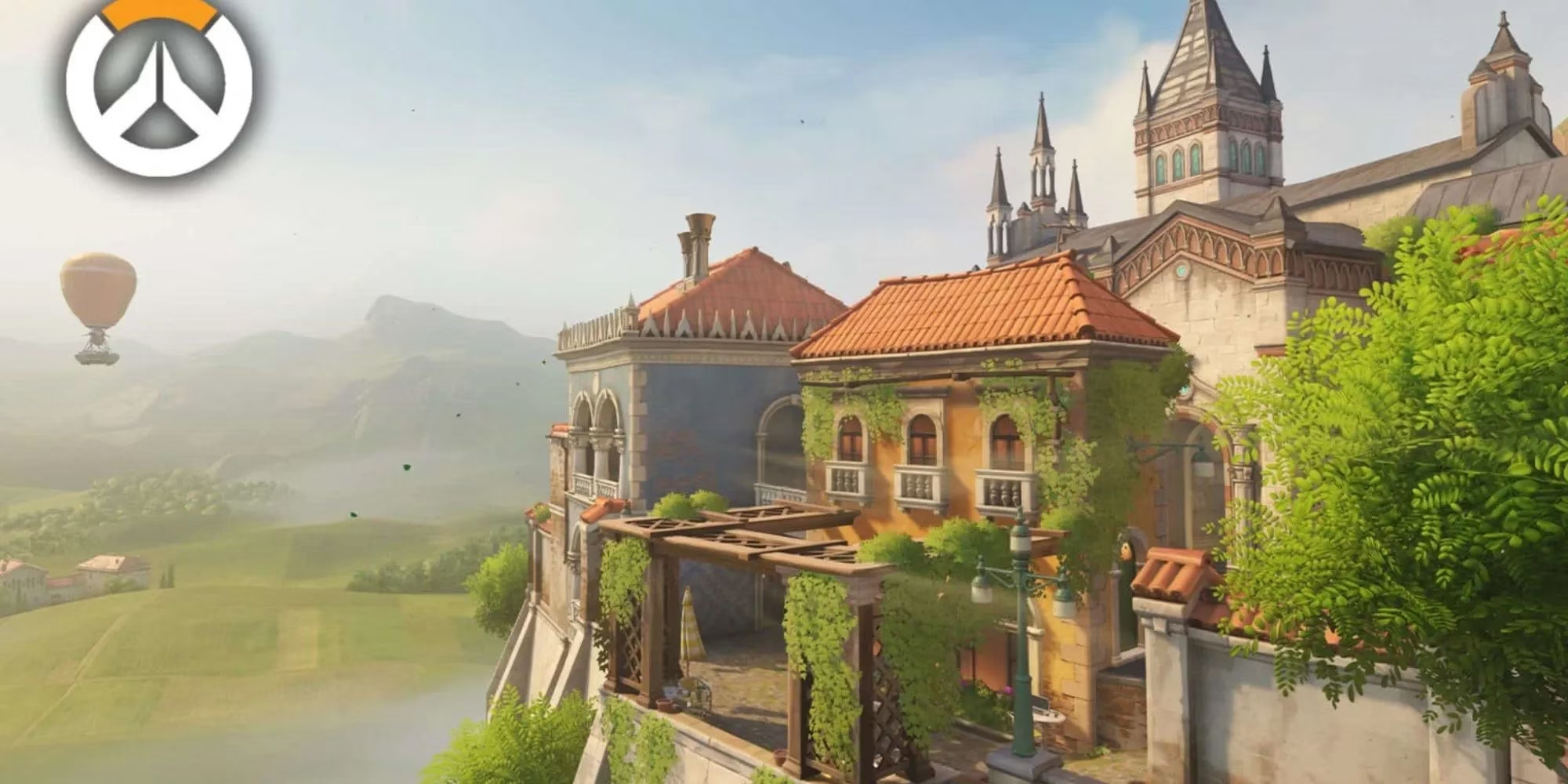
From above, the map resembles a crudely dissected Mediterranean hill town. Tight corridors twist through sandstone-scented alleyways, forcing encounters into breathless duels where a McCree flashbang could ricochet off a Fiat’s polished hood. The outer gardens spread in a crescent of lush greenery, offering snipers the kind of long sightlines that turned Widowmaker’s kiss into a death sentence. Meanwhile, the central plaza—the Talon hub—was a high-risk vortex. To claim the space was to dominate the scoreboard, yet the multiple entry points turned it into a blender of cooldowns and sudden respawns.
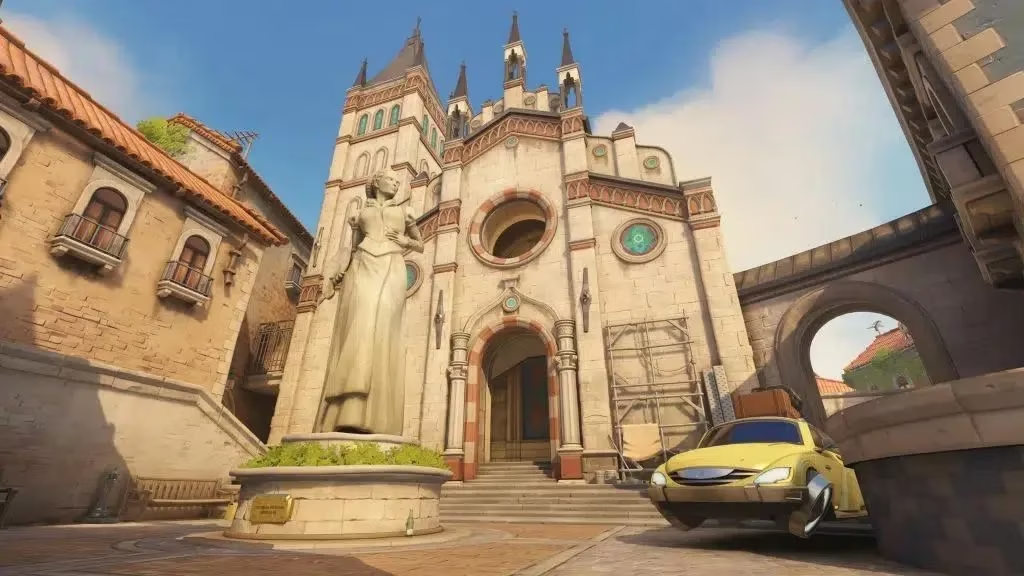
What made Malevento special was its ecological storytelling. Around every corner lay clues of Talon’s clandestine foothold—weapon crates disguised as wine barrels, encrypted data terminals humming beneath grapevine trellises. The map’s soundscape wove church bells with the distant whir of dropships, a juxtaposition as jarring as finding a plasma rifle inside a Renaissance chapel.
The official release, however, arrived not with a fanfare but a murmur. Hours before Malevento’s planned August 17 debut, California’s Department of Fair Employment and Housing had filed a blistering lawsuit against Activision Blizzard, alleging systemic sexual harassment and a toxic “frat boy” culture. The company’s social channels went mute; the usual patch-day exuberance was replaced by a queasy stillness. Players who logged into the Public Test Region found themselves walking the map’s silent streets in an atmosphere that felt less like a celebration and more like a ghost tour. The Dexerto preview, which had described a “secret Talon base that players will fight around,” became an ironic epitaph for a troubled developer.
In 2026, with Overwatch 2 now deep into its fourth decade of seasonal content, Malevento persists in the Arcade rotation as a curated anachronism. Many veterans treat it as a pilgrimage site, a physical reminder of the franchise’s pre-sequel era. The map’s design philosophy—dense verticality, multiple flanking routes, environmental props that double as cover—feels almost quaint compared to the sprawling Push maps or the chaotic Flashpoint locales of the modern game. Yet it is precisely this intimacy that keeps the queue times short on Friday nights.
Community cartographers and lore enthusiasts have spent years dissecting the map’s hidden narrative corners. The Talon compound’s lower level contains a datapad referencing the murder of Antonio Bartalotti, a callback to the “Retribution” event, which ties Malevento into the larger Overwatch mythos more tightly than its Deathmatch-only label would suggest.
The map’s resurgence in 2025’s “Classic Crate” event, where Blizzard temporarily reintroduced original Overwatch loot boxes and legacy map pools, gave Malevento a second wind. Streamers who had never touched the original Overwatch found themselves charmed by its Golden Age of Italy aesthetic—an artifact of a time when the game’s art team could lavish an entire Deathmatch arena with the same care typically reserved for core competitive maps.
Here are a few reasons why Malevento remains beloved:
🗺️ Tactical Layering – The outer vineyards provide escape paths for low-health heroes, while the central bell tower offers a high-ground anchor reminiscent of Château Guillard’s perch points.
🏎️ Vehicular Chaos – The vintage cars are not mere decoration; they can be used as improvised barriers against Pharah rockets, and their holographic underglow serves as a visual cue for incoming respawn waves.
🏛️ Architectural Absurdity – The blending of 16th-century masonry with Overwatch’s bright science-fiction palette creates a dreamlike dissonance, as if someone dropped a Sigma ult onto a Tuscan postcard.
Even Blizzard’s own storytelling acknowledged the map’s strange journey. In a 2024 developer roundtable, one environment artist reflected: “Malevento was built during a dark chapter. Releasing it felt like tossing a paper boat into a storm. Seeing it still floating years later is validating.”
The map’s corridors wind like the twisted roots of an ancient olive tree, funneling each skirmish into a private duel where mechanical skill overshadows team coordination. The Talon base itself, with its aggressive black steel jutting from limestone walls, resembles a predator mid-lunge, forever frozen in the act of consuming the quaint plaza around it. The silent launch window, too, clung to the map like morning fog—once thick enough to obscure everything, then slowly burned away by the simple passage of time.
Whether queuing for a quick warm-up or hunting achievements, players in 2026 still drop into Malevento’s sun-drenched labyrinth. The map, much like the game that birthed it, remains a testament to the idea that even beautiful things born in turmoil can endure long after the headlines fade.
Recent trends are highlighted by HowLongToBeat, and that time-and-commitment lens helps contextualize why compact, repeatable spaces like Overwatch’s Malevento stay sticky in 2026: when players want a fast warm-up or a low-friction session, a tight Deathmatch arena rewards quick queues, short bursts of mastery, and “one more round” pacing rather than sprawling, objective-heavy marathons.