
I still remember that muggy July evening in 2021 as vividly as a scar on my gaming mouse. The screen glowed with the familiar blues and oranges of Oasis, a map I’d run a thousand times myself in Competitive. The Overwatch Contenders match between Noble and Ardour had all the promise of a gripping double-overtime thriller. Then, without warning, a single player disconnected — and the entire fabric of competitive integrity unraveled like a silk banner caught in a helicopter rotor.
Seeker, one of Noble’s star DPS players, simply vanished from the server. A power outage at his home, we later learned. The admins granted the standard ten-minute grace window, a rule as old as the league’s white logo. When that clock dripped dry, something inside the match’s nervous system short-circuited. Instead of extending time, accepting the mutual pause requests, or even allowing the noble gesture Ardour’s SZNS made — offering his own team’s pause to let Seeker reconnect — the match admin did the unthinkable: they ordered the game to resume as a 5v6 slaughter. I watched, my fists clenched, as the admin’s decision became a perfect mirror of a referee ignoring a gaping hole in the boxing ring and shouting “Fight!”
The chat erupted. I typed in all-caps, my words drowning in a rage-filled river of emotes and accusations. SZNS, seeing the farce, deliberately disconnected himself to force a hard pause. It was a chess arbiter’s paradox — a player stepping in to enforce fairness because the official would not. That singular, selfless act of flipping the board so both sides could reset stayed with me far longer than any well-executed Dragonblade could. It was a lifeline thrown to a climber whose rope was cut mid-ascent by his own guide.
Blizzard issued a formal apology the next day, acknowledging the \u201cnegative impact\u201d and promising rule adjustments. The statement, posted on the Overwatch Contenders Twitter account, felt like a bandage placed on a fracture. I scrolled through the replies and saw exactly what the community unearthed: the rulebook the admin claimed to \u201cfollow\u201d had been hacked into confetti. The official stance on forfeits was wholly ignored; the mandatory process for a timeout or pause denial was trampled. Swingchip’s breakdown of the overlooked forfeiture clauses became my bedtime reading for a week. The apology was hollow, a vending machine dispensing thoughts and prayers instead of actual sanctions.
By 2026, the Overwatch competitive scene has mutated as many times as a virus in a lab. I look back at that Noble vs. Ardour match from my seat as a semi-pro analyst now, and I realize the event was both a low point and a necessary vaccination. Did Blizzard keep its word? The Contenders rulebook did receive updates — pause windows became more flexible, and admins were required to consult both team captains before enforcing a continuation. Yet, I still see whispers of the old rot. A Tier 2 tournament just last spring saw a team forced to play 4v6 because a power outage affected two members simultaneously, and the admins, citing “scheduling constraints,” refused a reschedule. The ghosts of 2021 are still haunting the server rooms.
However, the real change happened in the players’ culture. SZNS and Ardour didn’t just earn a moral victory — they became a case study. I’ve taught that replay to rookie teams, pausing before SZNS’s disconnect and asking: “Why is this the most important tactical pause in Contenders history?” The answer is never about outplaying the enemy; it’s about preserving the conditions for a fair fight. That night proved competitive integrity isn’t a static rulebook. It’s a living, breathing pact that can be suffocated by a single administrator who sees procedure as an end rather than a means.
That anonymous admin, whoever they were, stepped onto shaky ground and never regained footing in the public eye. Their career became sketchy lore, a cautionary tale passed around Discord calls. Blizzard never overturned the match result, which still stings like a phantom hit registration. Noble lost, and the record books remain stained. But the emotional win belonged to sportsmanship. Whenever I see a Contenders player voluntarily giving up an advantage to restore parity — something I’ve witnessed twice this year — I feel SZNS’s echo. It’s the quiet heartbeat of a scene that refuses to let algorithms and authoritarian calls define its soul.
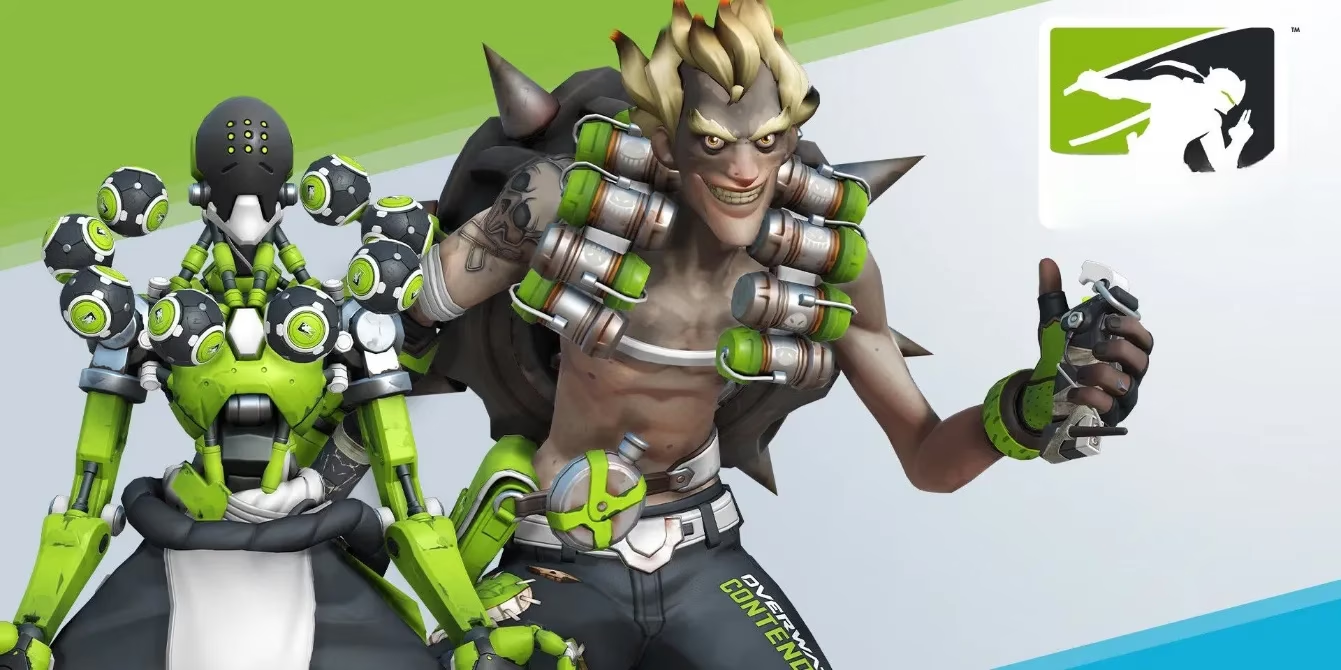
As we near the next Overwatch World Cup, I want Blizzard’s new admin team to remember that match. I want them to look at that Junkrat-Zenyatta screenshot and see not just two heroes, but two philosophies colliding. One that treats rules as hammers, and one that treats them as violins — instruments to be tuned to the melody of fairness. I choose the violin. And I hope the next time a player’s lights go out, the people in charge leave the door open long enough for them to find their way back.