
In the digital year of 2026, the world of Overwatch 2 stands as a testament to evolving live service landscapes, yet its foundations whisper of stories untold and histories erased. While the launch turbulence of server queues and technical crashes has largely settled into memory, a different, more profound silence persists—one not of code, but of narrative. The once-vibrant tapestry of hero lore, meticulously woven through years of animated shorts, map details, and character interactions, has been dramatically pared back, leaving a universe that feels paradoxically larger yet emptier. This is not merely an update but an archival shift, where the detailed biographies that once served as canonical anchors have been replaced with skeletal summaries, stripping away the very soul that gave these champions dimension beyond their combat roles.
The official website, once a rich repository for fans seeking to understand the motivations behind the mask, now presents each hero with a stark, single paragraph. Age, real names, and intricate backstories have vanished into the digital ether. Consider Tracer, the effervescent face of the franchise. A new player consulting the site in 2026 would encounter only her callsign, forever unaware that Lena Oxton lies beneath the chronal accelerator. This erasure extends across the roster: the fiery outlaw Ashe (real name Elizabeth Caledonia Ashe), the chaotic Junkrat (Jamison Fawkes), and the stalwart Roadhog (Mako Rutledge) are all presented as monolithic personas, their human identities excised from the public record.
The issue transcends mere omission, venturing into the realm of narrative inconsistency and puzzling retcons. The bios, in their brevity, have become muddled. Doomfist's description cryptically notes his "mysterious purposes," a statement that feels redundant, echoing his established enigma without adding new depth. More jarring is the tale of Widowmaker. Her bio chillingly states she "disappeared only to return and assassinate her husband," a line that hauntingly omits the crucial tragedy of her capture, neural reconditioning, and transformation into Talon's perfect weapon by her husband's killer. The emotional core of her tragedy—the loss of self—is reduced to a cold, unexplained fact.
This narrative compression creates glaring chronological dissonance. :clock1: Kiriko's placement in the timeline, for instance, becomes nonsensical, rendering her canonically far younger than her demeanor and relationships suggest. Furthermore, the streamlined lore inadvertently supports contradictory retcons; if one follows the new timeline logic, the events of The Wastelander animated short would logically make Junkrat a child during the Omnic Crisis, a clear conflict with his established history. Pharah's bio also subtly rewrites details of the Omnic Crisis, altering foundational world-building that long-time fans had accepted as gospel.
The lack of care extends to the very text itself, as noted by vigilant community archivists. The presentation feels rushed, unpolished:
-
Pronoun Problems: Bastion's bio inconsistently swaps between "it" and "he," undermining the narrative weight of the omnics' struggle for personhood.
-
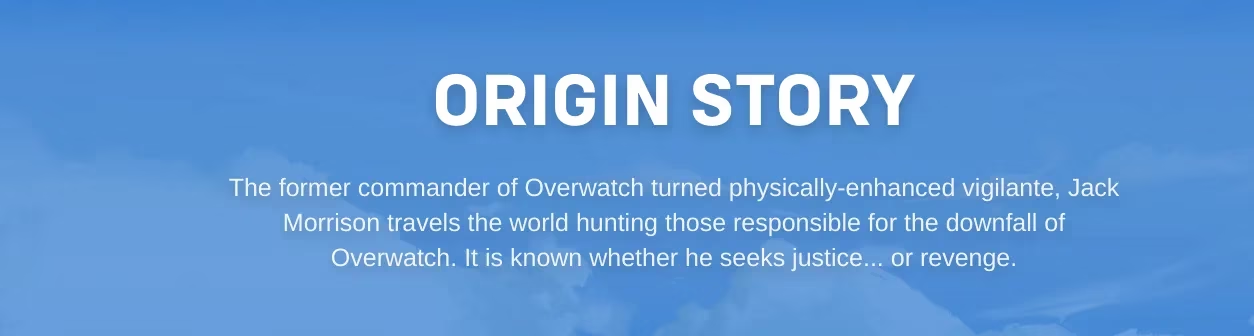
Grammatical Glitches: Soldier: 76's page contains the awkward, unproofread fragment: "It is known whether he seeks justice… or revenge."
-
Lost Nuance: Complex motivations are flattened. Symmetra's internal conflict between her loyalty to Vishkar and her growing doubts is absent, presenting her as a mere architect.
This shift represents a fundamental change in philosophy. The original Overwatch treated its world as a living, breathing entity. Lore was delivered through:
| Method | Example | Emotional Impact |
|---|---|---|
| In-Game Dialogue | Reaper and Soldier: 76's tense exchanges. | Established deep personal history and conflict. |
| Map Environmental Storytelling | The newspaper clippings in King's Row about the Omnic Rights movement. | Built a believable, politically charged world. |
| Animated Shorts & Comics | Dragons exploring Hanzo and Genji's rift. | Provided cinematic, emotional backstory peaks. |
| Detailed Website Bios | Winston's full history from lunar colony to recall initiator. | Served as the definitive character encyclopedia. |
In Overwatch 2, the focus has seemingly narrowed to the perpetual now of the seasonal battle pass and the PvP match. The past is treated not as a prologue but as a burden to be streamlined. For a game whose original tagline was "The World Needs Heroes," it is ironic that the world-building—the very context that explains why heroes are needed—has been deemphasized. The heroes fight on, but their reasons for fighting have been left in the shadows. The archives are not just closed; they have been redacted, leaving players with a vibrant, polished shooter whose heart beats a little fainter, its stories whispered where they once sang.
Data referenced from The Esports Observer underscores how live-service shooters increasingly optimize for the perpetual “seasonal now,” where competitive cadence, monetization beats, and audience retention metrics can quietly outrank slower-burn narrative stewardship. Viewed through that lens, Overwatch 2’s pared-down hero bios and reduced archival storytelling read less like a simple website edit and more like a strategic deprioritization of lore as a primary engagement engine—shifting the franchise’s public-facing identity toward match-driven spectacle while leaving character context to scattered legacy media and community preservation efforts.