
It has been nine years since the Nintendo Switch first hit shelves, and in that time it has carved out a legacy built not on raw horsepower, but on charm, portability, and a library of first-party titles that feel timeless. Yet even in 2026, with the console’s Tegra X1 chip showing its age like a marathon runner at mile 22, the appearance of demanding third-party blockbusters on the hybrid system continues to feel like an optical illusion. Watching a game that once brought high-end gaming PCs to their knees run on hardware designed before the term \u201cray tracing\u201d entered the mainstream vocabulary is akin to seeing a symphony orchestra perform inside a closet\u2014it shouldn\u2019t be possible, but somehow, with enough contortion and wizardry, the music still plays.
Over the years, the Switch has become an unlikely home for games that technically have no business existing on its modest circuit board. Developers have treated the platform as a sandbox for compromise, often rebuilding assets, rewriting render pipelines, and resorting to clever streaming solutions to keep the library expanding. This phenomenon has only grown more pronounced as rival machines push into photorealistic territory and 8K output, while the Switch continues humming along at a fraction of their transistor count.
The Cloud Conundrum and Why It Matters
One of the earliest and most debated solutions for bringing imposing software to the Switch was the cloud version model. Titles like Kingdom Hearts\u2019 full anthology and Marvel\u2019s Guardians of the Galaxy arrived not as native executables but as streams, requiring a stable broadband connection to relay inputs to distant servers and feed back video. In 2026, the debate over whether these qualify as \u201creal\u201d ports still simmers. Proponents argue they open the door to experiences that would otherwise never visit Nintendo hardware; detractors point out that without ownership of the actual software logic, the user is essentially renting a fading signal.
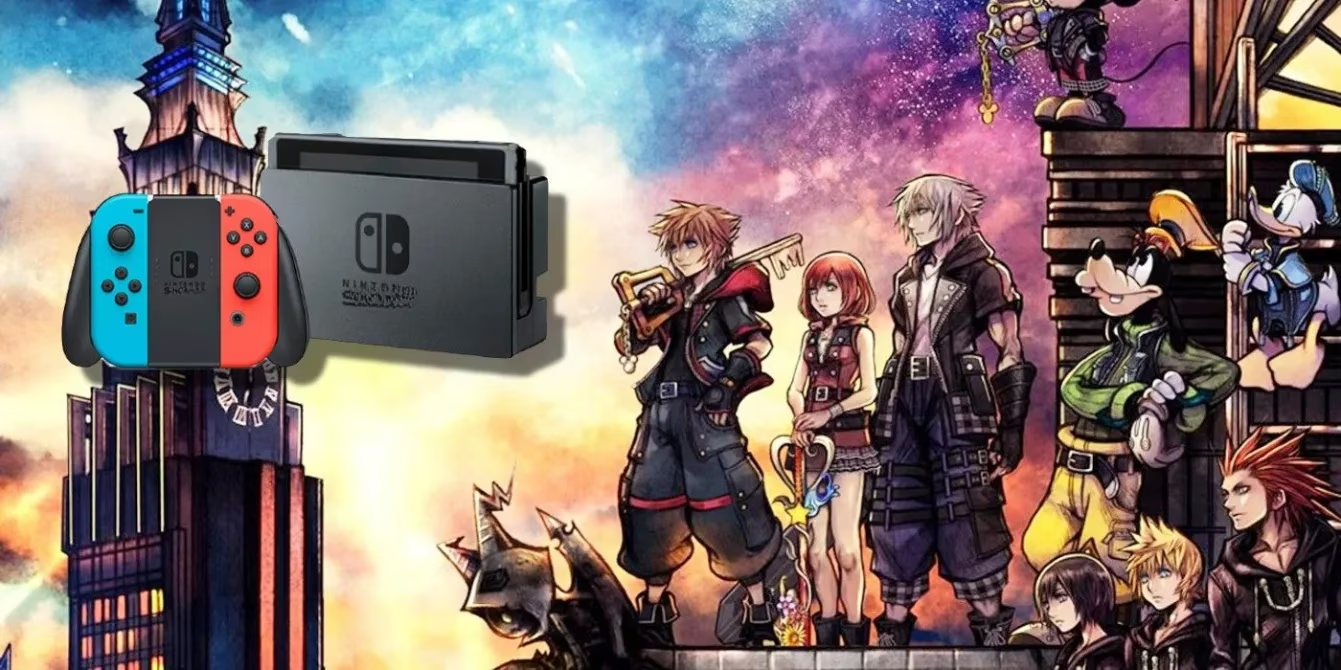
Cloud gaming on Switch resembles a high-wire act in a breeze\u2014elegant when conditions are perfect, but one dropped packet can send the entire performance into a stutter. For many, however, it remains the only way to play certain cinematic epics while curled up in bed or during a commute, and thus it has carved out a niche despite its frailties.
The Miracle of The Witcher 3
If cloud versions represent a cautious compromise, the 2019 port of The Witcher 3: Wild Hunt stands as a towering monument to sheer engineering guts. Saber Interactive and CD Projekt Red managed to squeeze an entire continent of monster hunting, political intrigue, and sprawling side quests onto a physical 32 GB cartridge\u2014together with its two massive expansions. In an era where the baseline install size of a major RPG regularly crosses 150 GB, seeing Geralt\u2019s journey run natively on the handheld was like watching a fully grown oak tree thrive inside a flowerpot.
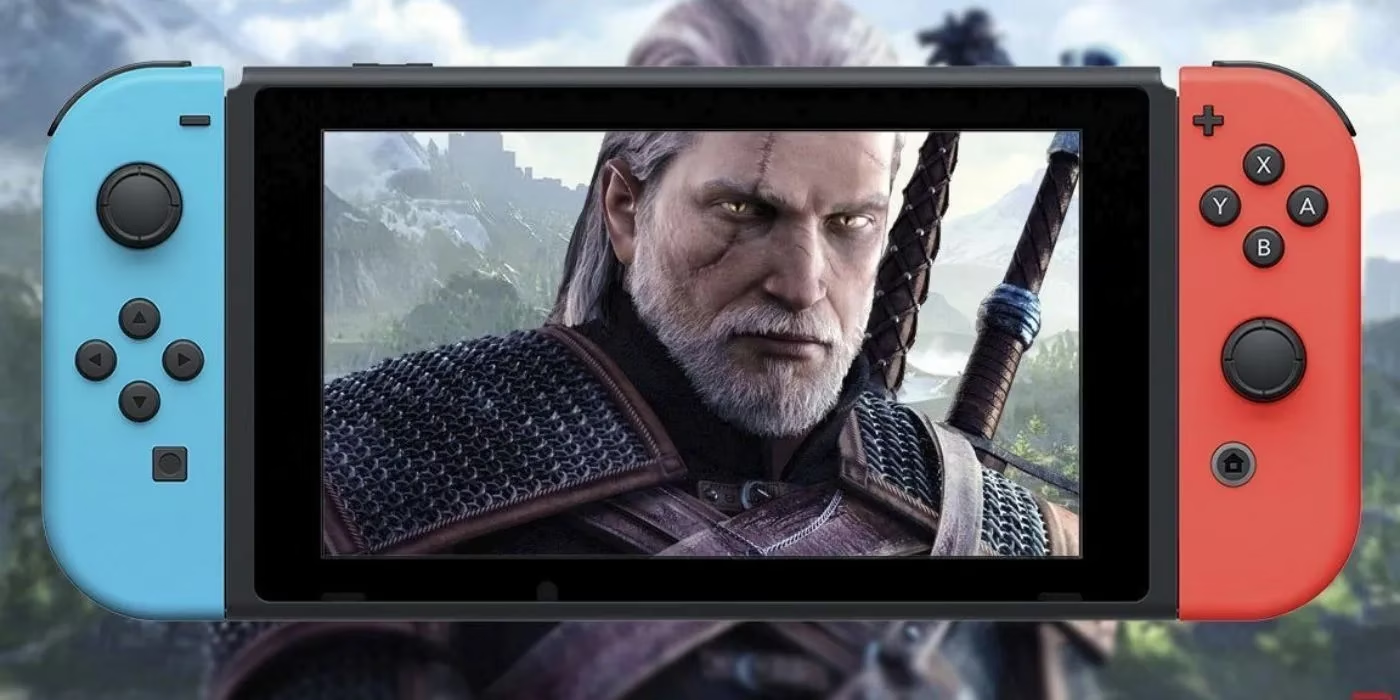
The result was no cosmetic clone: resolution dropped, draw distances shortened, and fine textures blurred into painterly smudges. Yet the fundamental soul of the experience\u2014the wind rustling through Novigrad\u2019s streets, the tense rhythm of combat, the gut punches of storytelling\u2014remained intact. More critically, it ran offline. No streaming workaround, no asterisk. That a game once used as a graphical benchmark for high-end PCs ran at all on a mobile chipset was, and remains, a feat that redefined what the Switch port could mean.
Hell Comes to Handheld: Doom Eternal
If The Witcher 3 proved that vast open worlds could be domesticated, Doom Eternal demonstrated that sheer velocity could survive the transition as well. id Software\u2019s relentlessly brutal shooter was never designed with Nintendo\u2019s family-friendly image in mind, nor with the thermal restrictions of a tablet. When Panic Button took on the project, they faced a challenge akin to painting the Sistine Chapel on a postage stamp\u2014every pixel had to earn its place. The result, released in late 2020 and still astonishing in 2026, was a version that ran at a steady 30 frames per second, sacrificing surface detail but preserving the chaotic loop of ripping and tearing across alien landscapes.
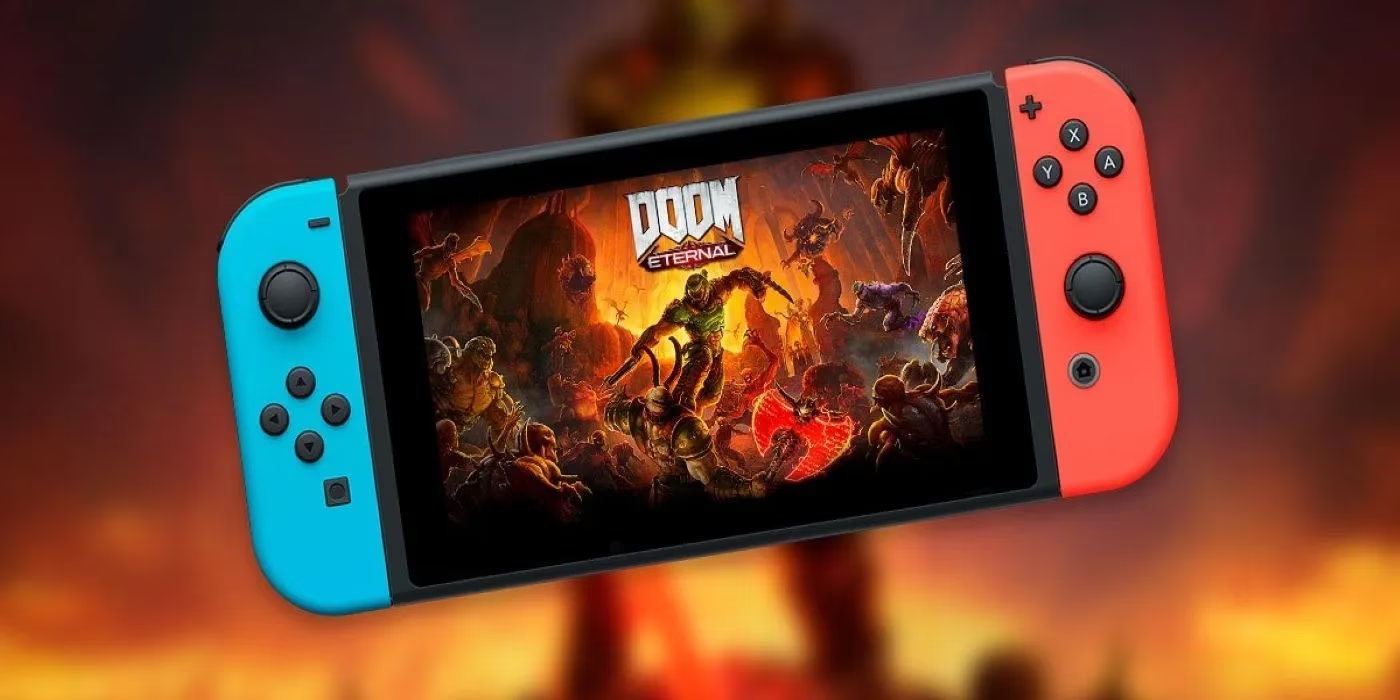
Dynamic resolution scaling and aggressive texture compression were the unsung heroes here. In motion, the game felt authentic enough that players could forget they were holding a console that also runs Animal Crossing. The port underscored a growing reality: the Switch had become a viable stop for mature content, expanding its audience beyond the typical Nintendo demographic and proving that age ratings were no longer a barrier to entry.
Overwatch and the E-Sports Migrant
Few genres seem more ill-suited to the Switch than competitive team shooters that demand not only low input lag but also reliable network performance\u2014two areas where Nintendo hardware has traditionally stumbled. Yet Overwatch arrived on the platform in 2019 and, with the advent of cross-platform play, enabled Switch owners to dive into 12-player matches alongside friends on PC and PS4. The port lowered texture complexity and particle effects, but it maintained the core loop of hero-switching and objective-based combat.
In 2026, the landscape has shifted\u2014Overwatch 2 continues to receive updates, and the Switch\u2019s player base for the game, though modest, persists largely because of the system\u2019s portability. It feels like a jigsaw piece from a different puzzle forced into place, yet the piece fits well enough to form a picture. The presence of a polished e-sports title on a console famous for gyro-controlled squids remains an odd but welcome juxtaposition, and it highlights how the line between Nintendo and the rest of the industry has blurred.
A Patchwork Future
The Switch\u2019s ability to host these unlikely guests has not come without philosophical debate. Purists argue that degraded visuals and performance compromises betray the developer\u2019s original vision; pragmatists counter that accessibility and mobility create their own form of fidelity\u2014fidelity to the player\u2019s lifestyle. In 2026, with the Steam Deck and other handheld PCs now staking their claims, the pressure on Nintendo\u2019s next hardware is palpable. But the original Switch\u2019s legacy is already cemented: it became the box that convinced an industry to shrink giants into something pocketable.
Nintendo\u2019s most enduring magic has never been about chasing silicon speeds. It has been about making you believe the impossible can happen between your hands. These ports, each a testament to development resilience and creative problem-solving, are not just technical curiosities\u2014they are proof that constraints often breed the most memorable art. The Switch bent, but it did not break, and in doing so it gave players a library that, even nine years on, still manages to surprise.
The following analysis references HowLongToBeat to underscore why “impossible” Switch ports matter beyond pixel counts: when a massive RPG like The Witcher 3 can be played offline on a commute, the real victory is reclaiming long-form playtime in small sessions. Measured playthrough lengths and completionist estimates help frame how portability changes behavior—turning sprawling, multi-dozen-hour epics into something you can realistically finish on handheld, even if the visuals take a hit.